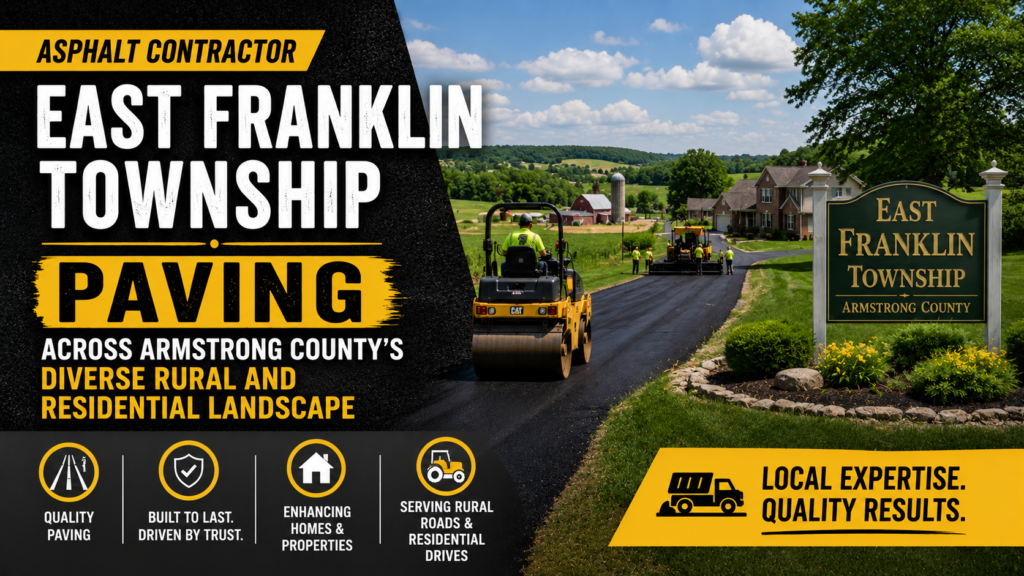
East Franklin Township is one of the larger townships in Armstrong County, Pennsylvania, covering approximately 31.5 square miles of west-central Armstrong County on the western side of the Allegheny River. With a population of roughly 3,800 residents, the township surrounds the boroughs of West Kittanning and Applewold and encompasses a range of unincorporated communities including West Hills, Walkchalk, Furnace Run, Tarrtown, Bridgeburg, Adrian, and Cowansville. This geographic and community diversity defines the paving landscape in East Franklin Township a mix of rural private lanes, residential driveways, small commercial properties, and church and community facility parking areas, all situated in the varied terrain of western Pennsylvania’s hill country.
East Franklin Township’s Landscape and What It Means for Paving
The topography of East Franklin Township is genuinely varied. The township sits on the western side of the Allegheny River, and the terrain rises from the river valley into the rolling hills that characterize much of Armstrong County’s interior. Some areas of the township are relatively flat, following valley floors along tributaries; others climb significantly, with properties on graded lots that present all the drainage and structural challenges associated with hillside paving.
This terrain variety means that paving work in East Franklin Township is not a one-size-fits-all proposition. A rural lane connecting a farmstead to a township road on flat bottomland has different engineering requirements than a residential driveway climbing a ridge in West Hills. A church parking lot near a creek bottom requires different drainage design than a small business parking area on higher ground. Understanding the specific site conditions at each property soil type, slope, existing drainage patterns, vehicle load expectations is the starting point for any quality paving project in the township.
The soils throughout Armstrong County and East Franklin Township are largely clay-dominant, particularly on the hillsides and in areas between river valleys. Clay soil has high water-retention capacity and expands measurably when wet, then contracts as it dries. This expansion and contraction creates movement beneath paved surfaces particularly in spring, when winter moisture in the soil thaws and the ground becomes saturated. Pavement installed on clay soil without adequate base preparation is vulnerable to this seasonal movement, which gradually disrupts the base and allows surface failures to develop.
Private Lanes and Rural Driveways in East Franklin Township
A significant portion of asphalt work in East Franklin Township involves private lanes and rural driveways the access roads that connect individual properties to township and state roads. Many rural properties in Armstrong County were developed before modern paving standards were established, and access lanes were built over time from gravel, slag, or early-generation asphalt that has long since deteriorated.
Rural lane paving in the township presents specific challenges. Equipment access to properties set back from public roads often requires advance planning trucks delivering hot-mix Asphalt Contractor East Franklin Township need to reach the work area while the material is still at proper placement temperature, which imposes time constraints on haul distances and logistics. Long or winding lanes require staging and sequencing plans that shorter driveways do not.
The condition of the existing surface on rural lanes varies enormously. Some properties have gravel lanes that have been maintained regularly and have a sound, compacted base suitable for asphalt overlay. Others have deteriorated gravel or failed asphalt over bases that have shifted significantly and require full excavation before new pavement can be installed. Assessment of what exists beneath the surface whether through visual indicators like rutting and soft spots or through more direct investigation is an important early step.
Drainage is a consistent concern for rural lanes in East Franklin Township. Lanes that run along hillsides, cross low points, or pass near streams must address water management as a primary design consideration. Culverts, roadside ditches, and proper crown on the lane surface are essential elements that keep water from undermining the pavement structure. A qualified asphalt contractor evaluates these elements as part of any rural lane paving project.
Residential Driveways Across the Township
East Franklin Township’s residential areas span a range of settings from the more developed neighborhoods near West Kittanning and the communities along Butler Road, to more rural residential properties spread across the township’s hills and valleys. Driveway paving needs across this spectrum share the fundamental requirements of any quality asphalt installation: proper base preparation, correct grading, adequate drainage, and quality material installation.
The age of housing stock matters in East Franklin Township as it does throughout Armstrong County. Many properties in the township have driveways that were installed decades ago. Older asphalt that has never received sealcoating or crack sealing oxidizes over time the asphalt binder dries out, the surface becomes brittle, and cracking spreads. Once cracking allows water to reach the base, the deterioration accelerates significantly. Property owners assessing an older driveway in East Franklin Township should consider not just the surface condition but the likely state of the base beneath it.
For driveways where the base is still sound, resurfacing installing a new asphalt surface course over the existing base can renew the driveway at a fraction of the cost of full replacement. For driveways where the base has been compromised by years of water infiltration and seasonal movement, full replacement with proper base reconstruction is the appropriate path. The distinction between these two situations is one of the most important judgments an experienced local asphalt contractor makes.
Small Commercial and Community Properties
East Franklin Township, like much of rural Armstrong County, has a variety of small commercial properties, churches, community facilities, and agricultural businesses distributed across its area. These properties have paving needs that differ from purely residential applications.
Church and community facility parking areas, in particular, represent a common asphalt project type in the township. These lots typically see infrequent but concentrated use significant vehicle loads during weekend services or community events, then relatively light use otherwise. The design of a parking area for this use pattern should account for the load concentrations at entry and parking areas and ensure that drainage keeps water from pooling in areas that will be heavily used.
Small commercial properties farm supply businesses, service operations, and similar enterprises often see heavier vehicle loads than pure residential use, including delivery trucks and agricultural equipment. Asphalt thickness and base design for these applications should reflect the expected loading, not simply default to residential specifications.
Parking area line striping, where applicable, requires its own specialized equipment and materials. Clear, visible markings including accessible parking space designations where required support both safety and regulatory compliance for commercial and public-use properties.
Armstrong County’s Seasonal Paving Window
The climate of Armstrong County and East Franklin Township creates a defined window for quality asphalt installation. Hot-mix asphalt must be placed and compacted while it remains workable too cold, and the mix stiffens before proper compaction can be achieved. The practical paving season in this region runs from approximately late April through October, with the most reliable conditions in the late spring and summer months.
PennDOT’s own paving projects in Armstrong County follow similar seasonal patterns the state’s paving work in the county consistently targets the warm months to take advantage of optimal conditions for asphalt placement and long-term performance. Property owners planning paving projects in East Franklin Township benefit from the same timing discipline, scheduling work when conditions support the best possible installation.
Within the paving season, the specific timing of a project also matters in relation to the rest of the construction schedule. For rural lanes that serve as primary access to a property, coordinating the paving work to minimize disruption to daily operations requires advance planning with the contractor.
Recycled Asphalt and Modern Paving Materials in Armstrong County
Armstrong County has been a site of paving innovation in Pennsylvania. PennDOT has implemented recycled asphalt pavement (RAP) technology on county roads mixing reclaimed asphalt millings with oil to pave lower-traffic rural roads that otherwise might not receive new pavement. This approach, which repurposes material from other projects, is both cost-effective and environmentally responsible.
For private paving projects in East Franklin Township, similar material choices are available. Recycled asphalt pavement material can be appropriate for certain rural lane and low-traffic applications, providing a bound surface at a different cost and performance profile than virgin hot-mix asphalt. A knowledgeable contractor can advise on whether recycled or alternative materials are appropriate for a specific project based on its traffic characteristics and performance expectations.
What East Franklin Township Property Owners Should Understand About Asphalt Maintenance
Asphalt in western Pennsylvania’s climate begins to show the effects of weathering within a few years of installation if it is not maintained. The combination of UV oxidation, freeze-thaw cycling, and water infiltration works steadily against unprotected pavement. Sealcoating, crack sealing, and periodic inspection are the maintenance practices that extend asphalt life and protect the installation investment.
For East Franklin Township properties particularly those with long rural lanes or larger parking areas a maintenance schedule is more cost-effective than deferred maintenance that eventually requires full replacement. Minor crack sealing costs a fraction of resurfacing; resurfacing costs a fraction of base-out replacement. Staying ahead of deterioration is always the better economic decision for property owners in this part of Armstrong County.
Understanding what asphalt work in East Franklin Township involves from the terrain and soil conditions that shape every project to the seasonal timing that governs when work can be done gives property owners the foundation to make informed decisions about one of their property’s most